AI in 2026: Business Leaders Need an Execution Strategy, Not Another Experiment
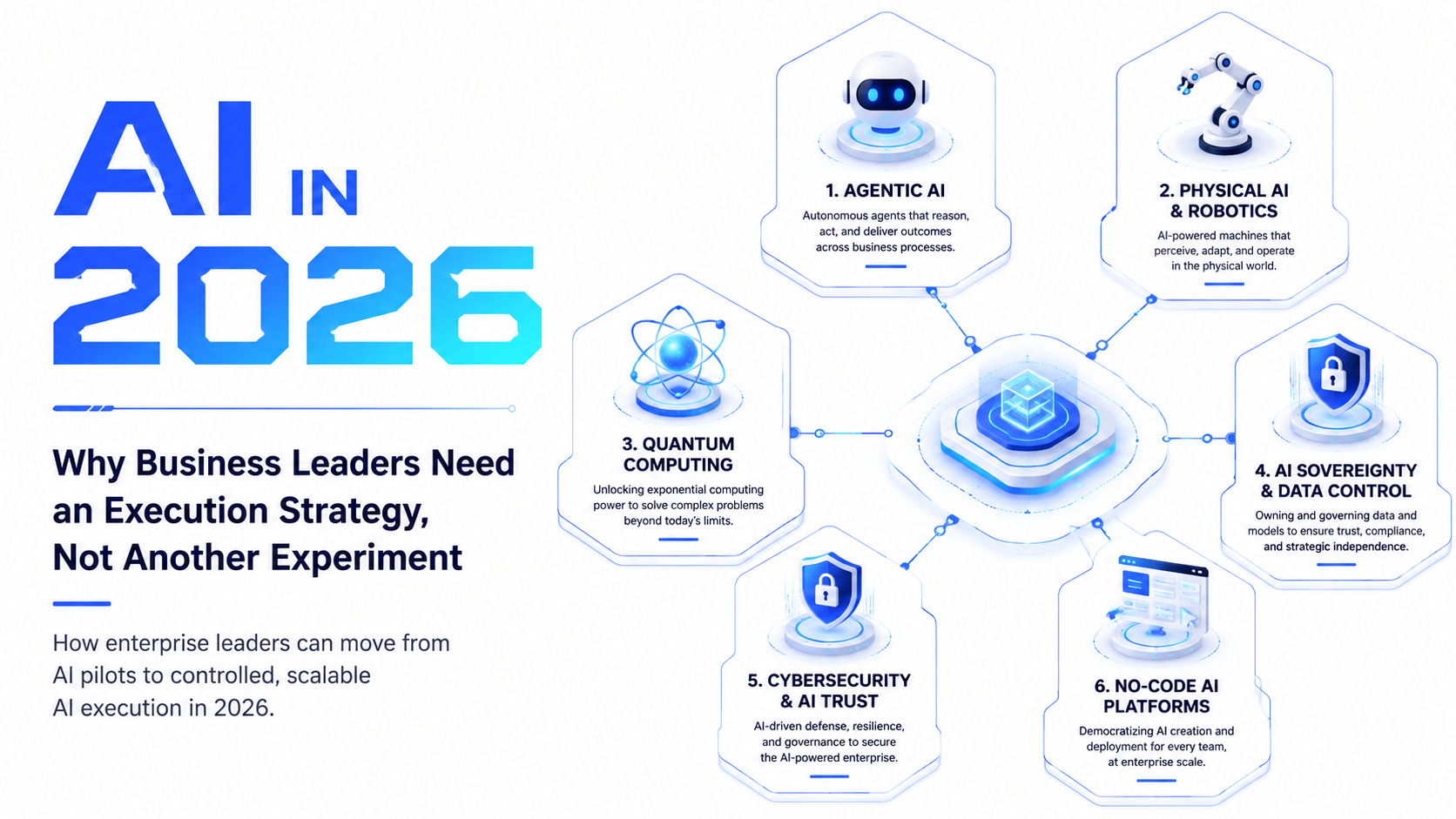
For many companies, the biggest AI risk in 2026 is not falling behind on technology. It is investing in too many AI tools without a clear operating model.
Over the past few years, enterprises have tested chatbots, copilots, automation tools, and AI assistants across different teams. Some pilots created real value. Many stayed stuck in demo mode. The core issue was not the model. It was the lack of structure around data, governance, workflow design, and business ownership.
That is why 2026 marks a clear turning point. AI is moving from experimentation to execution.
Business leaders no longer need to ask, “Can AI help our company?” The better question is, “Where should AI sit inside our operating model, and how do we control it at scale?”
From AI Tools to AI Workflows
The next phase of enterprise AI will not be defined by standalone tools. It will be defined by AI systems that can plan, coordinate, and complete work across business functions.
This is where agentic AI becomes important. Unlike basic chatbots that respond to prompts, AI agents can break a goal into steps, use business systems, retrieve relevant knowledge, and support task execution. In practical terms, this means AI can move closer to real workflows such as customer support resolution, finance reconciliation, production monitoring, document review, and internal reporting.
The strategic value is clear: AI becomes part of how work gets done, not just a tool employees open when they need help.
But this also raises a new leadership challenge. If AI agents can act across systems, then businesses need tighter control over permissions, data access, approvals, and audit trails. Without that layer, agentic AI can create operational risk as fast as it creates productivity gains.
Data Ownership Becomes a Board-Level Issue
AI performance depends on data quality. AI trust depends on data control.
In 2026, enterprise leaders will need to treat proprietary data as strategic infrastructure. The companies that win will not be the ones that send all their knowledge into generic systems. They will be the ones that build secure, well-structured, permission-aware knowledge environments that AI can use with control.
This is also why AI sovereignty is becoming a major enterprise concern. Businesses want more control over where their data is stored, how models use it, and which regulations apply. For industries such as manufacturing, finance, healthcare, logistics, and insurance, this is not a technical preference. It is a compliance and risk-management requirement.
The message is simple: AI cannot scale safely if the company does not know where its knowledge lives, who owns it, and who can access it.
Security Must Shift From Reactive to Preventive
As AI becomes more capable, cyber threats also become more advanced. Attackers can use AI to generate phishing content, automate reconnaissance, create synthetic identities, and exploit weak internal processes.
That means enterprise security must move beyond traditional perimeter defense. Companies need preventive security models that can detect risks earlier, protect sensitive data while it is in use, and verify whether content, files, and system actions are authentic.
For AI adoption, this matters because trust is now part of the product. Employees will not rely on AI if they cannot verify its outputs. Leaders will not deploy AI agents if they cannot monitor their decisions. Customers will not accept AI-driven experiences if data privacy feels unclear.
AI security is no longer an IT-only topic. It is a business continuity topic.
No-Code AI Will Expand Innovation, But Governance Still Matters
Another major shift is the rise of AI-native and no-code platforms. These tools allow non-technical teams to build workflows, apps, reports, and automations through plain language instructions.
This can unlock strong business value. Marketing, HR, finance, operations, and customer success teams can solve problems faster without waiting for long IT backlogs.
The counterpoint is clear: faster building can also create shadow IT. If every team builds its own AI workflow without governance, the company may face duplicated tools, inconsistent data, compliance gaps, and poor security practices.
The right move is not to block citizen development. The right move is to create a controlled environment where business teams can innovate within approved standards.
The Leadership Priority for 2026
The next wave of AI will reward companies that can connect three layers:
Business workflows
AI must support real work, not isolated experiments.Enterprise knowledge
AI must use trusted, structured, and permission-aware data.Governance and control
AI must operate within clear rules, approvals, and accountability.
This is the shift business leaders need to watch. AI adoption is no longer about choosing the newest model. It is about designing the enterprise system around AI.
For a deeper breakdown of the key technology shifts shaping the year ahead, read AIQuinta’s insight on Top AI Trends 2026: 6 Shifts Business Leaders Should Watch.
___________
AIQuinta - An Agentic Enterprise Platform, where your knowledge base powers AI.
- Website: https://aiquinta.ai/

.png)
.png)
Comments
Post a Comment