Why Enterprise AI Agents Need Both Tools and Skills
The strongest counterargument is clear: enterprises may not need a separate concept called “agent skills” at all.
If an AI agent can call APIs, run functions, query databases, send emails, and retrieve files, why add another layer? From an engineering view, tools already give the agent what it needs to act. Adding skills may look like extra architecture, more documentation, and more governance overhead.
That argument is valid, but incomplete.
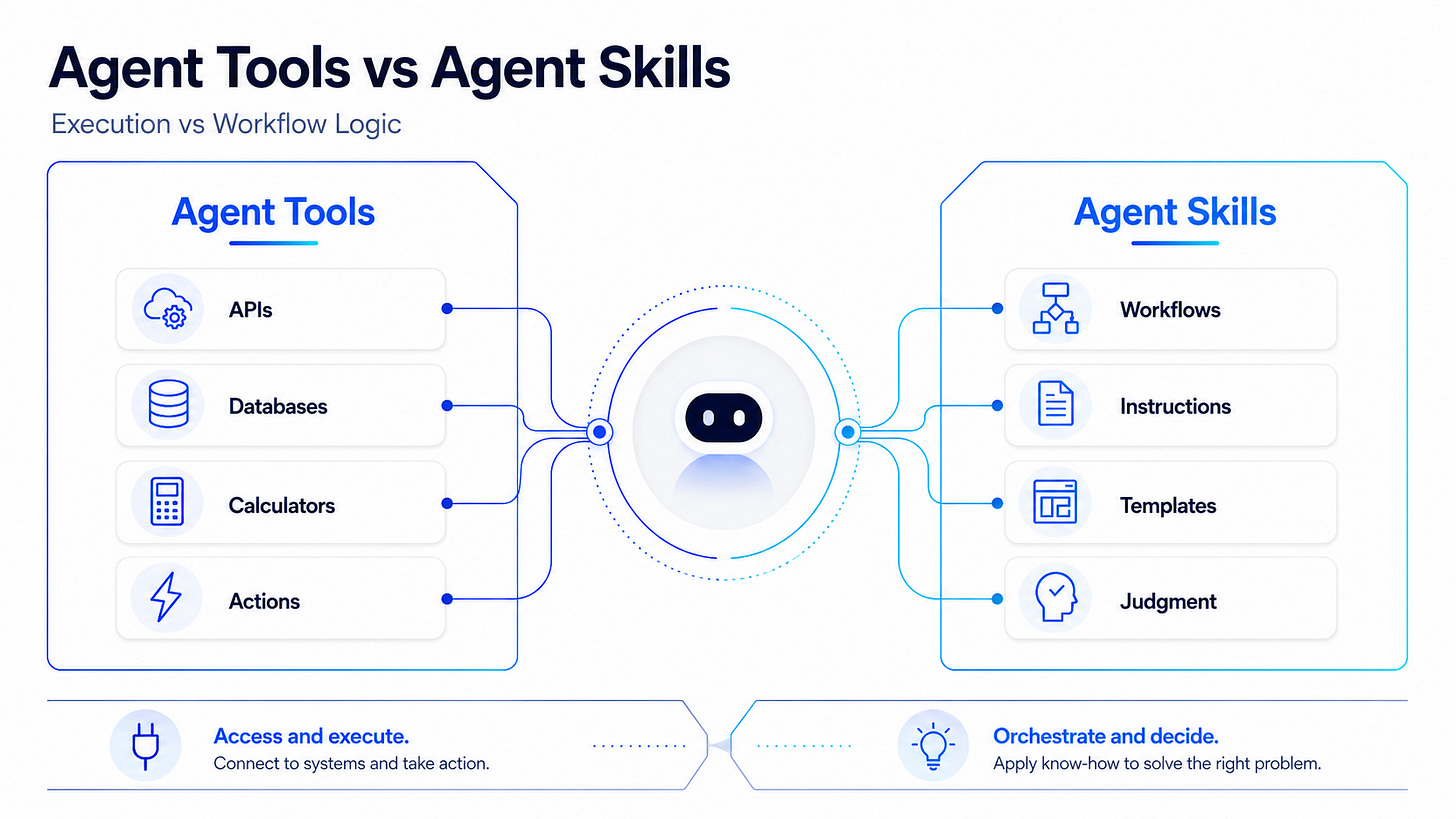
Tools help AI agents do things. Skills help AI agents do things the right way.
This distinction matters as enterprises move from simple chatbot experiments to production AI agents. A tool can pull live inventory data. A skill can help the agent interpret that data, identify risk, and prepare a clear action plan for the operations team. A tool can update a CRM field. A skill can guide the agent on when that field should be updated, what evidence is needed, and how to write the follow-up note.
That is why enterprise teams need to understand the practical difference between agent tools vs agent skills.
Tools give AI agents execution power
Agent tools are external functions, APIs, scripts, or system connectors that an AI agent can use to complete a task. They are useful when the work requires accuracy, live data, or a direct action in a business system.
For example, an AI agent may use tools to:
Retrieve customer data from a CRM
Query inventory from an ERP system
Run a calculation
Search an internal knowledge base
Create a support ticket
Send a notification
Generate a report from live data
In enterprise environments, tools are critical because the model should not guess operational facts. If the agent needs the latest sales pipeline, it should query the source system. If it needs to calculate a financial metric, it should use a trusted calculation tool. If it needs to update a record, it should work through a governed API.
This is why tools fit well with deterministic tasks. They have defined inputs, clear outputs, and measurable execution logic.
But tools alone do not create intelligent workflows.
A tool can give the agent access to a database. It cannot decide which data matters for a board report. A tool can send an email. It cannot decide the right tone for a CFO, plant manager, or procurement lead. A tool can retrieve a policy document. It cannot turn that document into a compliant recommendation without workflow logic.
That is where AI agent skills become important.
Skills give AI agents workflow logic
Agent skills are reusable instruction packages that teach an AI agent how to perform a specific type of work. They can include process steps, quality checks, templates, examples, constraints, and business rules.
A skill is not just a long prompt. It is a reusable operating playbook.
For example, a financial reporting skill may define:
Which metrics to review
How to compare current and previous periods
What risk signals to flag
How to format the executive summary
Which numbers require source validation
When to ask for human approval
A customer service skill may define:
How to classify customer intent
Which tone to use by customer segment
How to escalate urgent cases
What information to include in the reply
Which tool to use before giving an answer
This gives the agent a stable workflow instead of relying on each user to write a perfect prompt.
For teams that want to standardize repeatable AI work, the next step is often to define a SKILL.md file. This turns process knowledge into a reusable format that agents can load and follow when needed.
The real issue is not tools vs skills
The better question is not whether enterprises should build tools or skills.
The better question is: which part of the workflow needs execution, and which part needs judgment?
Use a tool when the agent needs to access a system, retrieve live data, run code, or take a direct action.
Use a skill when the agent needs to follow a process, apply judgment, structure output, check quality, or adapt work to a business context.
In most production use cases, the answer is both.
A tool gives the agent system access. A skill gives the agent operating discipline.
Why tool-only agents create business risk
A tool-only AI agent may look strong from a technical view. It can call systems, fetch data, and trigger actions. But in real enterprise workflows, this model can create risk.
First, the agent may produce raw outputs instead of decisions. Users do not need another interface that dumps data. They need a system that can turn data into business action.
Second, the agent may call the right tool at the wrong time. Without workflow logic, it may retrieve information before clarifying the task, update a system without enough evidence, or miss an approval step.
Third, quality becomes inconsistent. Different users may get different outputs because there is no shared operating standard.
Fourth, governance becomes incomplete. Tool access can be controlled through permissions, but reasoning quality, output structure, escalation rules, and business logic need a different control layer.
This is why AI agent governance must cover both execution access and skill-level workflow control.
Why skill-only agents also fall short
The opposite risk is building agents with strong instructions but weak system access.
A skill-only agent may produce a polished answer, but it may lack current data. It can summarize a process, but it cannot validate facts from live systems. It can recommend an action, but it cannot execute that action inside the workflow.
This is risky in areas like finance, manufacturing, insurance, logistics, and customer operations, where stale information can lead to poor decisions.
For example, a production planning agent may have a strong scheduling skill. But it still needs tools to check machine capacity, material availability, order priority, and downtime data.
A sales agent may know how to qualify leads. But it still needs tools to retrieve CRM history, check account activity, and update lead status.
A compliance agent may understand review logic. But it still needs access to policies, audit logs, and approved document repositories.
Skills create process consistency. Tools create operational connection.
The strongest model is skill-wrapped tools
The mature enterprise pattern is not “tools or skills.” It is skill-wrapped tools.
In this model, the skill defines how the agent should use tools. It sets the workflow, checks the inputs, guides the sequence, validates the output, and formats the final response.
For example, a manufacturing performance agent may use tools to retrieve:
Production output
Downtime records
Quality inspection data
Maintenance logs
Shift schedules
But the skill defines how to use that data:
Compare actual output with the production plan
Identify the bottleneck station
Check downtime by root cause
Review quality impact
Prioritize the next action
Summarize the issue for plant managers
This is how AI moves from assistant mode to operating mode.
The agent is not just searching, calculating, or calling APIs. It is running a business workflow with defined logic.
For teams building this architecture, the agent skill folder structure becomes important. Scripts, resources, references, and templates should be organized so the agent can load the right context at the right time.
Context control is part of the architecture
A common mistake is loading too much information into the agent upfront. More context does not always mean better output. In many cases, it increases cost, weakens focus, and creates noise.
This is why progressive disclosure for AI skills matters.
The agent should first see only the skill name and description. It should load the full instructions only when the task requires that skill. It should load deeper files, scripts, and references only when needed.
This keeps the agent focused. It also helps enterprises scale larger skill libraries without overloading every interaction.
The goal is simple: load the right context, at the right time, for the right task.
MCP tools and skills should work together
As enterprise AI architecture matures, teams also need to separate skills from tool protocols.
MCP tools are useful for exposing systems, data, and functions to AI applications. Skills are useful for teaching the agent how to perform work.
The production rule is straightforward:
Use tools to connect the agent to systems. Use skills to govern how the agent performs the work.
This distinction prevents architecture sprawl. It also helps teams decide what belongs in the integration layer and what belongs in the workflow layer.
From prompts to governed skills
Many enterprise AI workflows begin as prompts. A user writes a prompt, tests it, improves it, and shares it with the team.
That works for early experimentation.
But once a prompt becomes a repeated business process, it should not remain buried in personal notes or chat history. It should become a governed skill.
The shift from agent skills vs prompts is a shift from individual productivity to operational control.
Prompts are useful for one-time tasks. Skills are better for repeatable work that needs quality, consistency, and governance.
Conclusion
Enterprise AI agents need tools, but tools are not enough.
Tools allow agents to access systems, retrieve data, run code, and take action. Skills allow agents to follow business logic, apply judgment, maintain quality, and produce outputs that people can use.
A tool answers: what can the agent do?
A skill answers: how should the agent do it?
For enterprise teams, the priority is not to build more AI features. The priority is to build controlled, reusable, and scalable AI workflows.
That requires both layers: governed tools for execution and reusable skills for process intelligence.
___________
AIQuinta — An Agentic Enterprise Platform, where your knowledge base powers AI.
- Website: https://aiquinta.ai/
- Email: info@aiquinta.ai

.png)
.png)
Comments
Post a Comment